
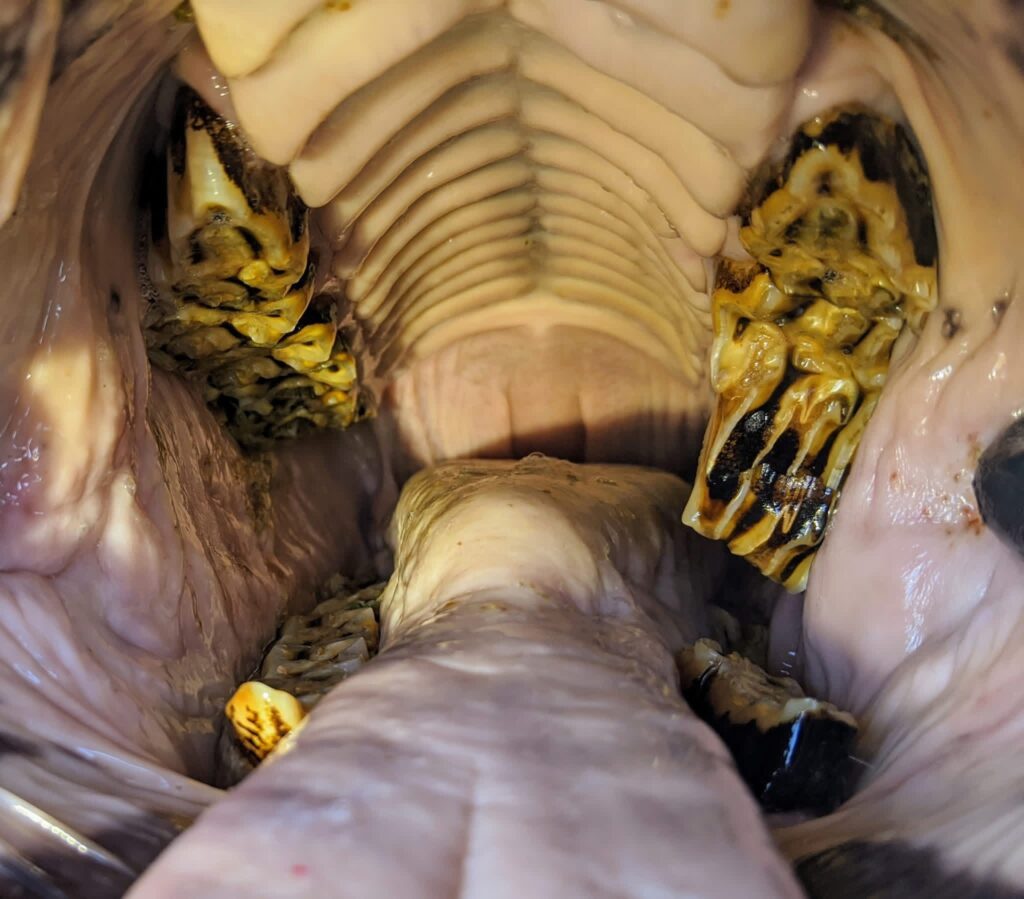

When horse owners think about preventive healthcare, vaccinations, hoof trimming, parasite control, and nutrition usually come to mind. However, one area that is often overlooked is dental health. A horse’s teeth play a critical role in their ability to chew, digest feed efficiently, and maintain a healthy body condition. Even minor dental abnormalities can have significant consequences over time.
A horse’s teeth continuously erupt throughout most of its life. This constant eruption replaces the tooth surface that naturally wears away as horses spend hours chewing forage each day.
A normal mouth has a relatively flat grinding surface where the upper and lower cheek teeth meet.
Wave mouth happens when these teeth wear down at different rates. If you were to look inside the horse’s mouth from the side, the chewing surface resembles a rolling wave rather than a straight, flat line.
This imbalance often starts with a single problem, such as:
* A missing or broken tooth
* Delayed loss of baby teeth
* An overgrown tooth
* Jaw injuries
* Abnormal chewing patterns
Once one tooth begins wearing differently than its opposing tooth, the imbalance continues to worsen. Because horse teeth never stop erupting, teeth that are not being worn down properly continue to grow, while opposing teeth wear excessively. Over time, multiple teeth become involved, creating the characteristic wave pattern.
Normal horses grind feed using both side-to-side and forward-backward jaw movements. Wave mouth limits these natural motions, making it difficult to properly chew forage and grain.
You might notice your horse dropping grain, soaking their hay in the water bucket, or tossing their head while eating. Over time, poor chewing leads to improper digestion, rapid weight loss, and an increased risk of impaction colic. The high spots can drive into the opposing gums, causing painful sores and infections.
Treatment and Recovery
During a dental exam, your veterinarian uses a full-mouth speculum, adequate lighting, and specialized instruments to examine every tooth. Sedation is often recommended to allow for a thorough and safe evaluation.
Treatment focuses on restoring a more balanced chewing surface through a procedure known as dental floating.
Severe wave mouth cannot be corrected in a single appointment. Filing down too much tooth at once can expose the sensitive pulp cavity, causing severe pain and permanent damage to the tooth. Instead, your vet will gradually correct the wave over several appointments spaced several months apart.
Annual dental examinations allow your veterinarian to identify uneven wear before it becomes severe and, in many cases, wave mouth can be prevented.
This column is sponsored by Polk Equine, and the opinions expressed herein may not reflect those of CFAN or of its advertisers.
BIO: Dr. Katie Hennessy graduated from the University of Illinois College of Veterinary Medicine in 2008 with a degree in large animal health and equine medicine. She completed an advanced internship at The Equine Medical Center of Ocala and is currently the owner and practicing veterinarian at Polk Equine. She specializes in equine medicine.